


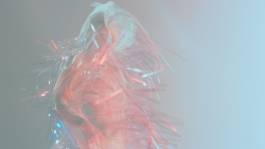



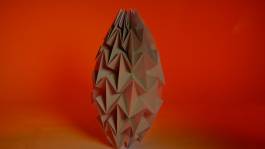

Linnea Bågander in collaboration with choreographer Nicole Neidert, “Skinning/True Mesh/16:9/full time texture”, 2019, Video still.
2019
LINNEA BÅGANDER
Experimentation and research are key words for understanding Linnea Bågander's work. Since she is trained in fashion design, another keyword is fashion, even if it is probably not the very first to come to mind when confronted with her videos, which show a figure in motion, entangled, enwrapped, cloaked with a wide variety of materials, which can be soft or hard, shapeless or geometrically structured. But in all this variation, the body is always central, both visually and conceptually, because Linnea Bågander’s research is focused on the body or, more precisely, on the space between the body and the garment. This space exists as a physical and a conceptual notion. Exploring this space means exploring the notion of wearing, which is fundamental to fashion. Extending and shrinking this space, outlining it with hard-edged sculptural forms or with soft and transparent fabrics, are all variations of this experimental process, which Linnea Bågander carries on with scrupulous meticulousness and a lot of curiosity and playfulness, with one central aim: to expand the range of what a garment is or can become.
Her recent work extends this investigation further through collaboration with choreographer Nicole Neidert, with whom she focuses on the performative aspects of materials, animated by the presence of the body in motion. The body, though, is almost unrecognisable as such, being completely absorbed within “costumes”, the main protagonists of each of six sets/scenes of the video. What creates visual narration here is the performativity of “costumes”, their ability to morph and transform, to materialise the movement of the body beneath. At the base of the word choreography lies the ancient Greek term “khoreia”, which stands for dance in unison, alluding to synchronicity and correlation of bodies in motion. Here, synchronicity and correlation are explored through the body and what covers it: soft, malleable, transformative structures created by Linnea Bågander.
Linnea Bågander did a PhD in Artistic Research, Fashion Design, at the University of Borås. Through collaborations within the field of dance, she is exploring dress as a performative element. She works with movement, materials and bodies, exploring how they co-exist and together create expressions and experiences. Her work ranges from how materials interpret and express the body's movements, to how materials give impressions, inspiration, and movement to the body, and to how these interactions create new bodies in interaction with the material. Before starting her PhD program, she worked in dance, performative art, and film as a costume and set designer.
Linnea Bågander in collaboration with choreographer Nicole Neidert, “Skinning/True Mesh/16:9/full time texture”, 2019, Video still.