


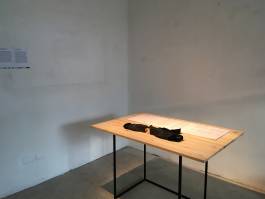
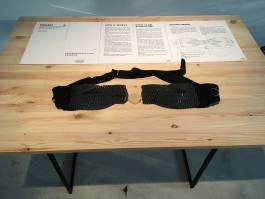
“DIGAART”, 2019, installation view, Ala Moderna del Museo della Città di Rimini, Photo: Szymon Owsiański
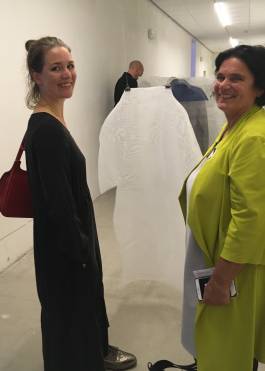
Opening of the exhibition “Transfashional”, Ala Moderna del Museo della Città di Rimini (Milena Heussler, Barbara Putz-Plecko), Photo: Tessa Chung (Yingntao Zhong)
2019
MILENA HEUSSLER “DIGAART”
“Matter of Impact” is the title of a project that Milena Heussler began developing in 2017 within the programme of the art education department at the University of Applied Arts in Vienna. After several years practising as a fashion designer and working under her label Mandlwear, which produced unique workwear pieces, she decided to take a course that would enable her practice to grow in a different direction, away from commercial commitments. It is a direction that privileges experimentation, collaboration, and reflexivity; a direction that is simultaneously propaedeutic and artistic.
With “Matter of Impact,” she began exploring the expressive potential of body-object interaction, developing a series of soft sculptural devices intended for use, as if they were part of some futuristic gym equipment.
They are designed for use, although their function remains unclear. In this way, they echo Franz West's “Adaptives,” wearable sculptures whose sole purpose was to encourage the wearer to perform and move in ways that deviate from traditional behaviour and accepted body language. Milena’s knotted wearable sculptures are tools that challenge the very concept of instrumentality.
They serve as instruments for prompting unusual interactions and narratives.
Following this, she created the next generation of this strange gear, which she calls “DIGAART”, a device which serves to detect and neutralise “social bias lurking in every algorithm.”
In the manual, which accompanies it, “DIGAART” is a wearable device with “a highly sensitive detecting apparatus, which finds the exact coding that implements the social bias (beta 1.3 version is focusing on gender bias, more advanced models are being developed).”
“In only milliseconds, the DIGAART rewrites the code using the revolutionary technique chimer, all developed by our team.”
What effectively “DIGAART” is could be called a sculpture and a story, both of which prompt us to think about the hyper-technologised reality we live in and will continue to live in. The need for this reflection is expressed in the manual accompanying this futuristic “product”: “When being in contact with any digital device, algorithms do a lot of problem solving and data analysis, and promise to make our lives easier. But recently, awareness of new problems arising from the structure of some algorithms is rising. It seems as if a lot of algorithms have a structural problem which makes them act sexist, racist, leaving out minorities, the old, the disabled, short, everyone and everything that doesn’t comply with the hegemonic standards of the ruling Western capitalist system.” So Milena proposes “DIGAART” - a shield and an antidote.
Milena Rosa Heussler is a fashion designer, born in 1983 in Zurich, Switzerland, and residing in Vienna since 2006. In 2012, she obtained her diploma from the fashion department of the University of Applied Arts Vienna, where she studied under Veronique Branquinho and Bernhard Wilhelm. In 2014, she co-founded the label Mandlwear, producing distinctive workwear for restaurants. The challenge of designing for daily use and overseeing production broadened her experience in the fashion industry. Aside from graphic design work for a Viennese publishing house, she has, since 2017, reconnected with artistic practice through her studies in the art education department at the Angewandte.
“DIGAART”, 2019, installation view, Ala Moderna del Museo della Città di Rimini, Photo: Szymon Owsiański
Opening of the exhibition “Transfashional”, Ala Moderna del Museo della Città di Rimini (Milena Heussler, Barbara Putz-Plecko), Photo: Tessa Chung (Yingntao Zhong)