


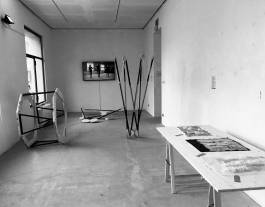
“Active Specimens / Puss caterpillar embellishment”, “Active Specimens / Leafhopper nymph 1 embellishment”, “Active Specimens / Leafhopper nymph 1 embellishment”, 2018, installation view (right), City Museum Luigi Tonini, Rimini, Photo: Szymon Owsiański
2019
NAOMI BAILEY-COOPER “ACTIVE SPECIMENS”
Trained in fashion design, Naomi Bailey-Cooper currently orients her practice towards textile design and the development of embellishments that test for more ethically responsible materials and methods. Her interest resides in finding out how fur and exotic animal materials can be substituted with alternative materials, which are equally appealing on an aesthetic and tactile level, but are produced in a sustainable and cruelty-free way. Moreover, how the principle of learning from nature can be implemented within the creative practice of a designer or an artist, her project “Active Specimens” is inspired by the way in which scientists record life in the Amazon Rainforest and how they work with live specimens.
Her aim, in her own words, was “to explore the recording of animal species by using a more poetic approach through textiles, which offer the qualities of movement and tactility lost in current physical samples.”
She recorded the activity of three different insect species from the families Puss caterpillars and Leafhopper nymphs. She transposed their movements and behaviour into the structure of textile artefacts, which, when handled, start to move, too.
For example - as Naomi indicates - “a leaf hopper nymph jumps away when touched, is represented through the application of magnets sewn into each embellishment which jump to and away from each other when handled.”
Textiles themselves are handmade, using materials such as organic cotton, manila hemp, waste silk, waste beads, banana fibre, wax, spun glass, latex, Tencel, and more, all produced responsibly and sustainably.
Thus, these textile artefacts, and their intrinsic characteristics, speak about values which designers and practitioners like Naomi Bailey-Cooper stand for: studying the principles on which nature builds itself and finding analogue ways to do the same, but without damaging, rather “mothering” Nature, to say it in words of Neri Oxman.
Naomi Bailey-Cooper is a fashion textiles designer and researcher working on a slower, more conceptual, artefact-based approach to fabric manipulation and embellishment outside the traditional fashion system. She is currently developing decorative alternatives to fur and exotic animal materials as part of her PhD study at the London College of Fashion, University of the Arts London. Her work featured in the “Fashioned from Nature” exhibition at the Victoria & Albert Museum. Previously graduating from Central Saint Martins in 2012, Naomi worked on a range of research- and design-development-based projects, including projects for Burberry and Gucci, as well as within a start-up capacity.
“Active Specimens / Puss caterpillar embellishment”, “Active Specimens / Leafhopper nymph 1 embellishment”, “Active Specimens / Leafhopper nymph 1 embellishment”, 2018, installation view (right), City Museum Luigi Tonini, Rimini, Photo: Szymon Owsiański